Summary
Pre2k misconfiguration → default machine account creds → ReadGMSAPassword → gMSA hash → ligolo-ng pivot → NTLM coercion + SMB→LDAP relay → Shadow Credentials → RBCD → LSA dump → ForceChangePassword → WriteSPN + KCD protocol transition → SPN hijack → S4U2Proxy → Domain Admin.
🩸 HTB — Pirate | Hard | Windows (Active Directory)
No spoilers. Just vibes, nudges, and the occasional raised eyebrow.
📸 Proof
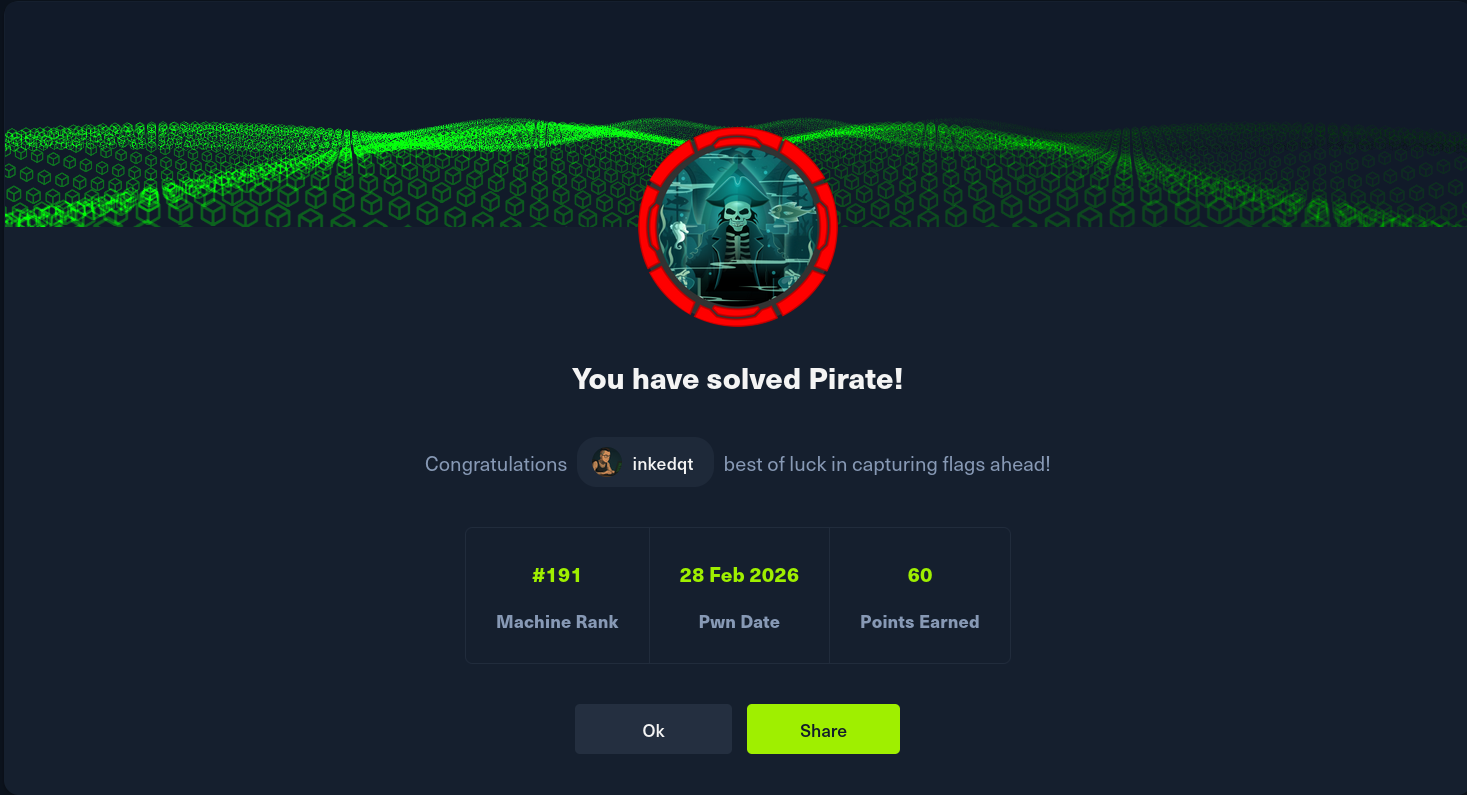
🖼️ The Vibe
A fully exposed Active Directory domain controller is waiting for you — and it’s been around long enough to carry some legacy baggage. This box is a love letter to real-world AD pentesting: no exotic CVEs, no magic tricks. Just methodical enumeration, credential chains, and a finale that requires you to actually understand how Kerberos delegation works under the hood. Every step follows naturally from the last. If you’re lost, you haven’t enumerated hard enough.
🗺️ The Path (Spoiler-Free)
🔎 Recon
You’re handed initial credentials. Use them.
Start with a port scan and let the results sink in — you’ll see the full picture of a Windows domain immediately. Take note of what’s signing and what isn’t. That gap matters later.
“LDAP and SMB are not the same. One of them has its guard up.”
Add the domain and DC hostname to /etc/hosts. Then run your standard AD enumeration toolkit: users, SPNs, group memberships. You’ll find a suspiciously familiar naming pattern among some accounts.
Hint: Two users share a surname. One of them has an _adm suffix. File that away.
Hint 2: Kerberoasting will yield hashes. Don’t spend too long on them — a locked door isn’t always the right door.
🔑 Foothold — Pre-Windows 2000 Compatible Access
This is where the box earns its name.
“What happens when a domain still trusts computers like it’s 1999?”
There’s a legacy group that grants broad directory read permissions. In modern domains it’s usually harmless. Here, it’s been applied with a very generous hand. Use a modern tool that has a dedicated module for finding exactly this class of misconfiguration — and look at what accounts are affected.
Hint: Pre-created computer accounts have a very predictable default password. The clue is literally in the account name.
Hint 2: Once you have machine account access, think about what privileged service accounts that machine might be allowed to read. Group Managed Service Accounts exist for a reason.
🏃 Lateral Movement — Into the Intranet
You now have a foothold on the DC. But there’s more network here than meets the eye.
“One NIC is never the whole story.”
Run an internal scan. There’s a second host hiding on an internal subnet. Set up a tunnel to reach it, then start fresh recon against that new target.
Check which machines have SMB signing enforced — and which ones don’t. That asymmetry is the entire premise of your next move.
Hint: NTLM authentication can be intercepted and redirected. SMB auth from an unsigned host can be relayed somewhere useful. You’ll need a listener, a coercion trigger, and patience.
Hint 2: Once you have an LDAP shell, think about what attributes you can write to computer objects. Shadow credentials are a thing.
🧗 User Flag
You’ve climbed high enough to dump secrets from your beachhead machine. The user flag isn’t where you’d expect it.
“Administrators don’t always get the good stuff. Sometimes you have to look in a colleague’s bedroom.”
Check what plaintext credentials came out of your secrets dump. One of them opens a door that BloodHound already told you about.
👑 Root — AD ACL Abuse + Delegation Gymnastics
This is the payoff. Everything you’ve built leads here.
You have a privileged user with a very interesting delegation setting. Not RBCD — the other kind. The dangerous kind, where protocol transition means you don’t need a victim’s Kerberos ticket to impersonate them.
“She’s allowed to act on behalf of anyone, to a specific service. The question is: whose service is that, exactly?”
The HTTP SPN is registered on the wrong machine for your purposes. AD is a database. Databases can be edited. You have write permissions.
Move the SPN. Then ask the KDC very nicely for a service ticket to somewhere else entirely.
Hint: getST.py has an -altservice flag. Read what it does carefully. This is the trick that turns a ticket for one thing into a ticket for another — as long as the encryption key lines up.
Hint 2: The entire attack chain is: WriteSPN → SPN migration → S4U2Self + S4U2Proxy → altservice rewrite → DC compromise. Each link connects logically to the next.
🧠 Skills This Box Will Test
- Pre-Windows 2000 misconfiguration enumeration and exploitation
- Group Managed Service Account (gMSA) password retrieval
- Kerberos time skew handling in real engagements
- NTLM coercion and cross-protocol relay (SMB → LDAP)
- Shadow Credentials / Pass-the-Certificate
- RBCD self-delegation via machine account
- Active Directory ACL abuse (ForceChangePassword, WriteSPN)
- Kerberos Constrained Delegation with Protocol Transition
- SPN hijacking for cross-host privilege escalation
💬 Parting Words
“She has constrained delegation with protocol transition. He moved the SPN. The KDC didn’t notice. Domain Admin arrived quietly.”
If you’re stuck at the relay step — check your MIC. If you’re stuck at delegation — check whether protocol transition is in play. If you’re stuck at the SPN step — remember that SPNs must be unique, and uniqueness means ownership can be transferred.
This box is a masterclass in chaining AD primitives. Each step is well-documented in the wild. The skill isn’t knowing one technique — it’s recognising which ones connect.
Good luck. Stay methodical. 🖤