// htb writeup
Linux
2026-03-08
Pterodactyl
Summary
A PHP web application box that rewards thorough enumeration before touching an exploit. Getting root requires chaining a lesser-known Polkit quirk with a race condition — patience and two terminals win the day.
🦕 Pterodactyl
Difficulty: Medium OS: Linux Release: HTB Seasonal
A PHP web application box that rewards thorough enumeration before touching an exploit. Getting root requires chaining a lesser-known Polkit quirk with a race condition — patience and two terminals win the day.
📸 Proof
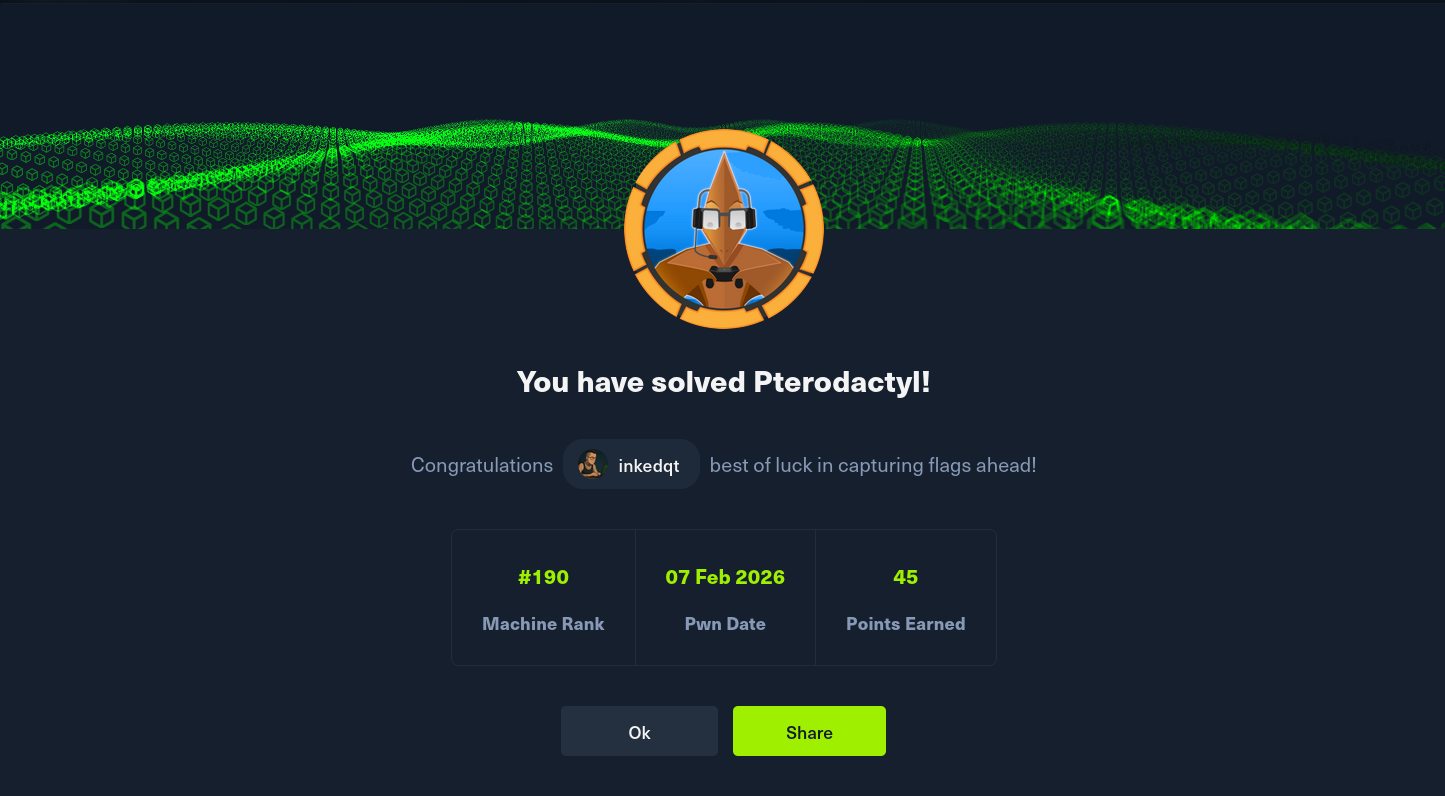 —
—
🧠 Concepts Covered
- Subdomain / vhost enumeration
- Web application fingerprinting and CVE research
- Local File Inclusion and chaining LFI → RCE
- PHP-PEAR as an unexpected code execution primitive
- Database credential extraction and lateral movement
- Offline bcrypt cracking
- Linux session model (Polkit, PAM, systemd-logind, seats)
- TOCTOU race conditions in privileged file operations
- XFS filesystem basics and disk image construction
💡 Hints (No Spoilers)
Foothold
- Don’t assume the first vhost is the only one. Fuzz broadly before deciding you’ve seen everything.
- The application is not a custom build — it’s a real open-source project. Find the exact version. There’s a file on the server that hands it to you for free if you look in the right place.
- Once you know the version, the CVE you need involves a specific API endpoint that transforms user input in a predictable way before passing it to the filesystem. Think about what “transformation” opens up.
- You have file read. Look at what’s enabled on the PHP install —
phpinfo.phpis your friend here. One feature being present changes “arbitrary file read” into “code execution” through a well-known technique. - The technique requires knowing where certain PHP files live on the system. Standard install paths apply.
User
- Your web shell runs as the web server user. You’re not going to
sudoyour way anywhere from here. - The application has to talk to a database. Find its config. Read it.
- The database has user accounts with password hashes. Not all of them are worth your time — pick the one that isn’t the admin and crack it.
- Bcrypt is slow but rockyou is not that big.
Root
- Check your mail. Literally. The system might be trying to tell you something.
- The privesc involves a Linux subsystem that doesn’t get much attention in CTFs. Read about how
udisks,Polkit, and session seats interact. - There are two CVEs here, not one. The first gets you elevated permissions you shouldn’t have. The second lets you abuse those permissions to execute code as root — but only for a brief window.
- SUID binaries are blocked on normal mounts. Think about when “normal” rules might not apply during a privileged operation.
- You’ll need two terminals open and a tight loop. The race window exists — it’s just not very generous.
- Build your payload statically. Dynamic linking assumptions will bite you.
📚 Useful Reading
- Pterodactyl Panel documentation (understand the locale/translation system)
- PHP-PEAR docs — specifically
pearcmd.phpand how it handles command-line arguments - Polkit documentation —
allow_activevsallow_any, and what constitutes a “local” session pam_env(8)man page — what~/.pam_environmentcan and can’t do- udisks2 documentation — loop device setup and filesystem operations
mkfs.xfsand XFS resize behaviour- hashcat wiki — bcrypt mode
This box is part of an active HTB Seasonal rotation. Full writeup will be published after the box retires.